Posts

Internet Weather Links

  Weather is kind of important for a solar RC airplane.   We don't want rain, or too much cloud, or too much wind.   So we will collect some links here, trying to move the best toward the top, for checking weather near us.   WindGuru Aguilla Seafeathers Bay - Can see how much cloud, rain prediction, wind speed and direction.  Windy.com East Anguilla - map showing wind at different date, time, altitude  Caribbean Radar Composite - Radar from all around the Caribbean.  Can see where it is really raining right now.  ANIMATION SATELLITE et RADAR de METEO FRANCE - Radar from satellites Tropical Weather, Hurricane Watches - major storms                

Switching from iNav to Ardupilot for Flight Controller

   We had been using iNav software for the flight controller but have decided to switch to Ardupilot the following reasons:    1) Ardupilot can have a "companion processor" like the Jetson Nano that does vision/AI and decides things like which way to go.   We really want to explore what can be done with AI on a solar powered airplane.   Like can it avoid clouds and stay in the sun more, can it scan the horizon with a telephoto camera looking for boats, can it head for a boat automatically, etc.   This seems fun.    2) Ardupilot can use a companion processor to communicate over cell data network (4G) to a ground station.  With this we could fly all around Anguilla and still have communication between the ground station and the airplane.  So from the ground we can change the mission plan during the flight.    We could decide to go to a particular boat, or decide to come home because the change of rai...

Copper Clad Aluminum Wire

Image
  Aluminum wire is 61% as conductive a copper and only 30% of the weight .   So for the same amount of conductance it is half the weight.   Since weight is an important thing on a solar airplane, this is interesting.  The first problem is that the layer of oxide on aluminum makes it very hard to solder to.   We need to connect wires together, so this is a problem. There are copper clad aluminum wires .   The core is aluminum but the outside is copper.   This way you get most of the light weight of aluminum but you can still solder to it like copper.   Below is a picture: A bundle of thin strands seem to have a bad reputation for corroding if outdoors.  I am hopeful that a single solid core, about 1.5 mm diameter, would last well enough for me.  However, I am can't find this on Amazon so far. There is a place in China that might work .   There is a useful website for calculating power loss in a wire depending on ...

SN1 - First custom plane

Image
We are working on a clean sheet wing design that has perfect places for 8 solar panels, Jetson nano, DJI Air Unit, supercapacitor, motors, servos, wires, etc.  But the CAD software for this is at the office and in our current Covid situation working on solar airplanes is "non essential", so not a good enough reason to leave the house.   Also leaving your house to fly RC airplanes has been against the law for the last 3 weeks, as I understand it.   We have planned to eventually make a VTOL plane.  Since such a plane could fry from our house, even during lockdowns, this seems like a higher priority now. Also, we have the "test wing" that we made just to see if the idea of CNC cutting a frame out of foam and covering it was reasonable.  We can probably make get this to fly and learn something, since it is at home and we can play with it.   This can be a step toward our VTOL plane. The first step was to use a hacksaw to cut out a bit from each le...

Cloud Dodging in the Caribbean

Image
  Caribbean clouds are often only covering part of the sky.   If there was 30% cover and we flew our plane around randomly we would have much reduced solar 30% of the time.   But if we planned our route to optimize solar power, we could do much better than that.   At first we could do this manually but eventually we would like AI to deal with this automatically.        With a Jetson Nano we have plenty of power to work on this problem. If we had it tracking clouds objects (number for each cloud) as we moved to the side we could see how much the angle changed for each of the clouds and figure out how far away they are.   This type of depth perception is called depth from motion .   I think this won't be too hard really.   Some papers related to this topic 1)  Cloud Detection System for UAV Sense and Avoid: Cloud Distance Estimation using Triangulation     $33 US for non-members   Abstract: Sense and Avo...

Motor Mount in Foamular 250

Image
 The Foamular 250 we are using is rated for compression of up to 25 psi (lbs/sq-inch).   It is more stiff than other foam I have seen in model airplanes and a bit heavier.   We cut out the foam where we don't need the strength, so we are not hurt by the weight.   For motor mounts it seems like this extra strength could let us just gorilla glue some screws into the foam.   We tried this and it seems to work fine.  For this experiment we used M2x20 screws.  So 2 mm diameter and 20 mm long.  The motor mount uses 4 screws but for this test we only used 2.   We drilled two holes in the foam and filled them with water (poking small nail in to get all the air out).   Then we covered the screws with gorilla glue and put them in.  First we tried just putting a weight on to hold them in: But it was hard to get it to hold both screws down well.   So we put a piece of plastic over and a clamp and let it cure overnight. So for the...

Stabilized Camera / Pan-Tilt

Image
  With a "two servo micro gimbal" you can tell iNav to stabilize your camera.  The flight controller already has tilt sensors and a computer, so with the iNav software setup right it can control the servos and stabilize a camera.  You do need to have 2 extra servo outputs on the flight controller.     There are a number of these on Amazon.   If we just search Amazon for "servo gimbal Mini Pan-Tilt mount FPV" there are several for under $25 but you may have to put in your own servos.        You can also 3D print the plastic parts and add your own servos.   This is for a Raspberry Pi or Jetson Nano type camera but should not be hard to get it to hold a DJI Camera. There are also head trackers so that the airplane can point the camera where you turn your head.  This increases the feeling of being on the airplane, so can increase the fun.

Mr Watt Solar Plane

Image
  We bought a solar plane from Mr Watt more than a years ago but with Covid and other things we did not unbox it till today.   Below Teryn and Amoni are opening the box:   And out of the box but not ready to fly it looks like this.   It is really big. When they did a test flight in Italy it looked like this: Along with Covid part of the delay was we did not know of a place to fly it.  Anguilla's two large grass fields both have problems.  One is in town near the airport.  The other is under the approach path to the airport.     We had hoped to work out landing in a net and did fly a plane into a net on a couple occasions but were not happy with this idea.   Since then we have found a remote beach that seems a good place to fly from .    Another problem was how to do the camera, energy storage, computer, and radio control in the rated 500 grams.  We did not know how to do this when we ordered the ...

Jetson Nano and AI / Vision

Image
  It would be nice if a solar drone could detect ships for boarder patrol, people in the water for rescue, and clouds for maximizing solar collected by the plane.  It could then plan a route to get closer pictures of ships or people and avoid clouds.  This paper on ship detection also compares Jetson Nano to Raspberry Pi and shows that Jetson gets more processing per watt.   We have thought this too and have been playing some with Jetson Nano.   In ArduPilot a Jetson Nano can be the companion computer for both 4G cell data and for image processing/AI stuff.  It can run at 5 watts and is about 135 grams.    The Jetson Nano is about $100. It has a big brother the Jetson Xavier NX that is about the same but with a fan and 15 watt top instead of 10 watt.  The NX costs about $400 and has about 10 times the AI performance of the Nano.  Though with the NX you probably also want a fast SSD, which could add another $100 or so.  After ...

S800 Group Build, Project Rosetta Stone

    This seems a great source for learning iNav:   S800 Group Build, Project Rosetta Stone    

Cellular Data Connection

Image
 If we can use cellular data to connect to the airplane then it could go really far and we could stay connected. 4gUAV Peter J Burke connected 4G to an airplane and wrote about it .  He also wrote some later papers with projects using 4G .  So far we are just looking at how to do it but will probably do this at some point.   The first thing is a USB to 4G adapter like:     Next a very tiny Raspberry Pi Zero W : Then it seems ArduPilot is needed.  It runs on the flight controller but talks with the Raspberry Pi as a companion computer .   The 4G modem plugs into the Raspberry Pi.   Peter has setup a 4gUAV gitlab repository that is really the place to go.  Here is a video where Peter flies a plane just from over cellular. UAVPAL Disco4G   Also interesting is  UAVPAL Disco4G .  This uses a drone that can operate over wifi and puts a cell hotspot/wifi on it.  This has latency issues for control. ...

Facebook group Solar RC Airplanes

  I created a Facebook group called Solar RC Airplanes .  I am hoping to find other people interested in this topic.   If you are and use Facebook please join that group.

Nature's Flyers Tricks For Efficient Travel Over The Ocean

Image
  Nature's flyers (Birds, bats, and insects) have some tricks they use to travel over the ocean without using much energy.  Some travel long distances over the ocean while hunting (sea birds) and others mostly for migrations.   I am collecting some of the tricks nature's flyers use to save energy here with the idea that maybe drones could use some of these eventually. 1. Dynamic Soaring         By moving back and forth between two layers of air that are moving at different velocities an Albatross can soar for long distances over the ocean.  The video below explains how it works.           This trick is a bit like sailboat.  A sailboat has a sort of wing in the air and then a sort wing in the water (keel) and gets energy from air while the keel keeps it from being pushed downwind.   An Albatross gets energy out of the air when it is up high and then pushes off the low air to...

MPPT in iNav software

Image
  Solar panels produce the most watts when operated at some ideal voltage called Vmppt. Normally people use special hardware called an MPPT controller to draw power from the solar at that voltage and then convert it to the right voltage for a battery. We have worked out a program for iNav so that this extra hardware and weight won't be needed.   The idea is to adjust the throttle higher if the voltage is higher than ideal and to lower it if the voltage is lower than idea.   Since we already have a computer onboard that knows the battery voltage and controls the motors, we can get things operating at the ideal voltage just using some software.  This will help keep weight down on solar airplanes we make.   We also save any conversion losses or power limitations of the MPPT hardware.   You can see this in the video and the picture after that.     Here is a shot of the program: A shot of the supercapacitor, flight controller, volt meter: ...

Putting Solar on Opterra 2M

Image
  The manufacuter of our F2X5S solar panels,   solarealdrone.com , said they use Super Glue (with Cyanoacrylate) to glue them on foam planes.   The nice thing is it dries really fast.  We got some Gorilla Super Glue.   Here is a video the company made about how to attach panels to a foam wing and wire them up: To fit the solar panels on our Opterra we needed to remove some bumps on the top of the wing and cut a bit off the edge of the ailerons.   To remove the bumps we used a couple guides and a small hotwire as shown below: We cut out a piece of the aileron and glued it in the old gap to make end section fixed to the rest of the wing, so there was a bit more room for the solar panel. We taped one edge of the solar panel so it could act like a hinge and make the solar panel in the right spot as we were rushing to do the glue.   We lifted it up, put the glue on the foam close to the hinge side, then folded down the solar panel and held i...

Bird Wingtips

Image
  There are birds, like this Great Blue Heron, that have several separated feathers at the wingtips.   This is a bit like having propellers pushing the air down at the wingtips.   It helps prevent higher pressure air below the wing from sneaking around the end of the wingtip to the low pressure area above the wing.  Click pictures to enlarge them.     Thanks to David Stokely for the two pictures above.  A few other pictures showing this type of wingtip. This video shows some large birds with this type of wingtip.

Wingtip Propeller Theory

Image
  There have been a number of studies of how efficient putting propellers on the wing tips would be.   We will try to collect some good ones here.   Below is a video of a simulation: Below is a list of papers:   Analysis and Design of a Small-Scale Wingtip-Mounted Pusher Propeller   Aerodynamic Analysis and Optimisation of Wingtip-Mounted Pusher Propellers  Experimental and numerical study on wingtip mounted propellers for low aspect ratio UAV design If you want to place solar panels on a wing, it is easier to have a rectangular wing.  I think for this shape wing the wing tip losses as a glider would be more severe and so having wing tip propellers makes for a bigger win than normal shape wings.

Solar Panel Unboxing

Image
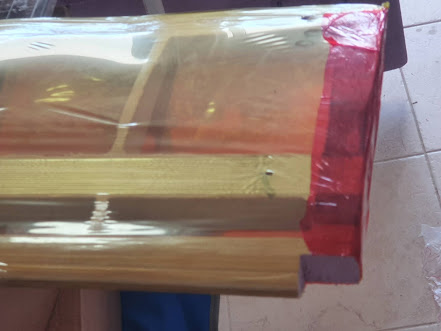
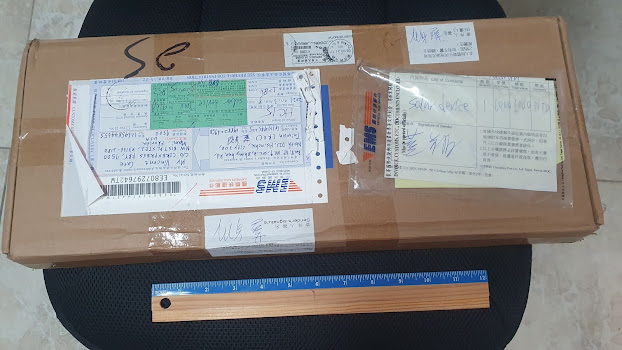
  We got our solar panels from  solarealdrone.com !   They were very well packed and all seem fine.  The cost was $1.90/watt.  They are so small and light that express shipping from Taiwan to the USA was very reasonable.   They also included 2 MPPT boards and some wire good for solar panels for free.  The solar panels are about 15 inches by 5.5 inches. We got 18 solar panels and the total weight for all 18 was about 528 grams or 29.3 grams per panel. The side view showing how thick a stack of 18 solar panels is: The back of one panel showing wiring: These panels are their F2X5S panels.   The MPPT voltage for these is 5.72V and at that voltage it produces 2.04 amps for a total of 11.66 watts. Next to get them on a plane and into the air.   These seem like a very good product for solar RC airplanes.   Very happy with them so far.     We will probably put 4 on an Opterra (46.4 watts) and then 8 o...